CLICK HERE FOR BLOGGER TEMPLATES AND MYSPACE LAYOUTS »

Monday, February 13, 2006

Transitional Violence

Imani Henry. B4T. Highways Performance Space. 2/9/06.

I'm glad Imani Henry is telling his story. B4T is an interesting and valuable look at the pains and difficulties of three "Black, masculine, female-bodied people." These are stories that need to be told, and I am very much glad that I heard them. Henry is a talented performer, doing a fairly good job at establishing separation between 3 similar characters and doing an excellent job at keeping the audience engaged throughout. He talks skillfully at the intersections of race, class, gender and sexuality, and those positions and perspectives are important.

What bothered me about this piece, however, was its conceptualization of transition. B4T didn't seem particularly intended to educate the viewer about transition in any way, which is fine, but it consistently depicted testosterone or medical transition as a violent rupture in the speakers' lives, and I'm not entirely comfortable with that. For LaShawnda, the most visibly female-bodied of the three characters, the decision to transition was configured to suggest suicide. For Keith, who seems to be post-transition but reminiscing, he discusses how he could never go back, couldn't or wouldn't go to a high school reunion or see the friends who knew him to be a girl however much he was one of the guys. For Imani, the violence is in his inability to explain an impending transition to his dying grandmother, the enforced silence that comes from a not entirely accepting family.

The other thing that bothered me about the piece was its profound rejection of the term 'lesbian.' While it's perfectly understandable that these characters who don't consider themselves women might have problems with being labeled 'lesbian,' the revulsion for the term wasn't carefully teased out in this piece. Keith's absent interviewer, placed in a strange position of authority by her absence and seemingly elevated posiiton, was apparently a lesbian and Keith asked her 'why can't you tell your own stories,' creating and exacerbating a distance between himself as subject and the interveiwer as academic, lesbian, and seeminly priviledged. There was an extremely difficult moment, almost unexplored, in which Keith said that his girlfriend of 10 years was a lesbian, and it was profoundly unclear about whether that meant that she still identifies as lesbian or just that she did when they met. And either way, how does he feel about that? How does she feel about that? These absent female partners were pushed into an extemely awkward erasure throughout the piece in that both Kieth and Imani acknowledged girlfriends, but failed to represent them or even talk about them coherently Similarly, the butch and FTM person of color slide show that bridged the gap of a costume change featured several photos in which the subjects were kissing girlfriends, but those girlfriends were similarly unrecognized.

The success of B4T is in performing 3 different characters telling their stories in relationship to race, gender, and identity. The failure was in showing why and how these were three different characters. Why and how weren't they 3 aspects of Imani telling his own story? Would it have been more powerful speaking from a place of explicit identity rather than semi-autobiographical fiction? I would have liked to see more about where and why these characters divereged and conflicted. Why and how were each of them before T? I found myself wondering how long Henry had been performing this piece. How distant is the moment before T? How has this piece changed as his body has changed? Why not tell a story after T? B4T is a step in the right direction in terms of making more explorations of identity available and raising issues related to gender and sexuality. There are a lot more steps out there, and I'm excited to see them all.

Thursday, February 09, 2006

I think I've got a V-day plan!

It appears that The Sex Workers' Art Show is going to be in LA on Valentine's Day. First of all, the universe is clearly trying to kill me; I'm far too busy for ANOTHER show that I must see. Second of all, why did I not know about this? Third of all, I must go. How could I miss Michelle Tea and Scarlot Harlot?

Here's some copy from the show's website:

The show is a critically-acclaimed eye-popping evening of visual and performance art created by people who work in the sex industry to dispel the myth that they are anything short of artists, innovators, and geniuses!

The wildly-successful cabaret-stlye show is hitting the road again to bring audiences a blend of burlesque, spoken workd, music, and multimedia performance art as well as a visual art display that travels with the show. Intelligent and hot, disturbing and hilarious, the performances offer a wide range of perspectives on sex work, from celebration of prostitution and sex-positivity to views from the darker sides of the industry.

Tuesday, February 07, 2006

The '50s were sooo kinky!

Monroe, Marilyn. Gentlemen Prefer Blondes. 1953.

Wow, this movie was strange and different and even kind of hot. I totally loved it. Monroe called her boyfriend 'Daddy' throughout the movie, which sounds so weird to contemporary ears. You certainly don't hear things like that now. Also, there were strange situations involving a young (pre-adolescent) boy actually admitting he had a sex drive and kind of ridiculously hitting on Marilyn Monroe and Jane Russell. You might sometimes see that today, but it's something that freaks us out much more these days.

The thing that really got me was the bondage chandelier. In the "Diamonds are a Girl's Best Friend" dance number, there were, for no apparent reason, several girls dressed in strips of black fabric or leather and chains holding up candelabras. It seemed very kinky and completely unnecessary. Is this the evolution or a mimickry of a Bugsby Berkeley dance number?

The movie in general was delightful, but odd. Though it rather scandalized me, this demonstrated that the '50s, at least in this manifestation, were better about being open (and not guilty) about sex than movies are now. Richard Dyer (Heavenly Bodies) argues that Gentlemen Prefer Blondes is the least appropriate of Monroe's movies for her personality, and I sort of understand that. Lorelei was an interesting character, but Monroe's breathy innocence seems inconguous with Lorelei's cynical greed. It makes her seem really creepy and manipulative, which is odd because you're sort of supposed to sympathize with her.

Anyway, I completley enjoyed this movie. It was fun and amazing, and the campy Jane Russell and the naked athletes scene featured in The Celluloid Closet was especially wonderful. I totally see why Monroe was seen, according to Dyer, as the embodiment of a pure and natural sexuality breaking away from conservative morality. I love it!

Seriously, though, despite all of the feminist film theory I've been reading, I was very much seduced by the spectacle and visual pleasure of this film. The costumes were lush and gorgeous, and Monroe and Russell were a striking and dynamic pair. And with Russell's height and sharp features, the two of them would make a lovely butch/femme couple. And of course, the utter, ridiculous, nonsensical, outrageousness of the whole plot and situation of the movie kept me broadly entertained.

Monday, February 06, 2006

Not sure I know what to say about this one

Pappa Tarahumara. Ship in a View UCLA Live. Royce Hall. 2/4/06.

I tend to be suspicious of anything where a synopsis or review claims that their work is "capturing the enduring wonder and indescribable beauty in all things", and I'm still rather suspicious after seeing this performance. Pappa Tarahumara is a Japanese modern dance troupe that is, I believe, vaguely butoh-inspired. I have nothing like the vocabulary and knowledge to provide an informed review of their performance, and I make no pretense to understanding it, but I will say that I felt fairly intellectually engaged. Pieces of it kind of reminded me of Merce Cunningham work I've seen (or at least the bicycle bit from Variations V). The LA Times Review provides a decent thrashing of the work. The production was cool and grey and the effect overall was rather mind-numbing, although I didn't know what was going on, so I was paying fairly close critical attention. There was some gesture toward a plot and setting, but it was unclear and poorly developed. Supposedly the production was a representation of a seaside town in the 60s, but I'm not sure how I was supposed to know that other than the fact that the program told me.

I did have a rather large problem with the piece in terms of gender, though. There were some interesting gender issues, including the fact that one (or possibly two) members of the ensemble were men wearing dresses, which was curious in a good way. The bad thing, however, was that the production seemed incredibly phallocentric. There was a giant pole in the middle of the stage, for goodness sake. And twice, men climbed the pole to perform, but women never did. There was also a man (not in a dress) who sat upstage center for almost the the entire performance in a clear position of patriarchal authority. I found him rather suspicious. And, most of all, there were two women who seemed to represent aspects of female sexuality, and whenever either of these two women, the one with the curly hair and the one with the bob, did anything suggestive or overly wild, they were punished with sexual violence. There were two moments in which the woman with the curly hair was roughly embraced by a man whenever she got close or flirtatious with him and she had to break away violently. The girl with the bobbed hair, at some point near the end of the show, spent a few minutes with her dress up showing the audience her underwear for no apparent reason. Immediately following that, she was practically nailed to some boards upstage. The gender and sexuality in this performance was profoundly disturbing to me.

The most frustrating thing about the performance was its false ending. There were several points where it felt like it was building to a climax and a conclusion that never came. At about an hour and 15 minutes into the production, they were in the middle of something that felt very much like the end. It was about my limit of endurance and the music seemed to be reaching an ending and I was all ready to start clapping and watch them take their bows, but NO, without giving the audience any kind of mental break they continued into a whole new section where everyone changed clothes and they did it all for no apparent reason. This new section seemed in no way dramatically different from any of the other work that came before.

Tuesday, January 31, 2006

Reasons to love a musician

I ordered katastrophe's new CD, fault, lies, and faultlines as a little birthday present for myself and it arrived today. I haven't even listened to the CD yet, and I'm already in love with it, and katastrophe, because with the CD I got a handwritten note thanking me for the order and telling me "I hope that you enjoy the CD and you find a special song." It's a small gesture, but I found it totally sweet. It made me want to give him more money, or at least to order a new copy of Let's f*ck, then talk about my problems (a CD which I loaned to a friend and never got back). Maybe after the next paycheck. Anyway, I look forward to listening to fault, lies, and faultlines.

Monday, January 30, 2006

"There's nothing wrong with being alone"

"What gives you the audacity to believe you've failed if you can't make life or stop death?
Because I was taught if I was a good girl and worked hard I could" - An American Daughter

Wendy Wasserstein died. I'd been hearing for a while about her cancer, but it's still a great loss. She was only 55.

Her New York Times Obituary calls her a "Chronicler of Women's Identity Crises," which I believe does her a disservice, though the article itself below the headline does a much better job of explaining exactly why and how she mattered so much. She was one of the few women playwrights who consistently, sucessfully had plays produced on Broadway. And she wrote strong roles for strong women. Isherwood describes her as a predecessor to Sex in the City, but she dealt with the lives of women who, though equally privileged, felt very real to me rather than fanciful romantic constructions of wealth and glamour. Female friendships, family relationships, feminist politics, and single motherhood suffused many of her plays. I regret thoroughly that I have never actually seen a production of one of Wasserstein's plays, but as an undergraduate in college I read them and fell in love with them.

I will honor her by reading one of her plays tonight, and I hope others will consider doing the same. She was a wonderful female voice in a theater that remains very much a boy's club, and she deserves recognition as a major American playwright. She won a Pulitzer Prize and wrote roles for which actresses like Lynn Thigpen won Tonys, but I never studied her in a drama class and only discovered her when assigned a scene from one of her plays in an acting class. She, like many other female playwrights, was marginalized and underestimated because she wrote about women. I hope now she will get the recognition she deserves for her bold theatrical discussions of gender in our society today.

UPDATE: Jill Dolan writes a beautiful post about the ambivalences surrounding Wasserstein's feminism of the priveledged. She calls her assimilationist and questions her for not being more critical, but raises the question of whether or not that's a bad thing. It's a beautiful reflection on memorializing someone about whose work you've been critical in the past.

Saturday, January 28, 2006

A happy birthday story

This story made me very happy. Yay!

L!: The Lesbian Musical!

The Breakup Notebook. Hudson Backstage Theater, Hollywood. 1/27/06.

Apparently, lesbian musicals are a good place to meet gay men. Or at least the audience was filled with them this particular night. The Breakup Notebook was a totally fun, funny, lesbian-themed musical and there was a lot of laughing out loud throughout the show. The music was fun and happy and generally really well done and the cast clearly worked hard and were quite talented. In fact, I thoroughly enjoyed the whole evening.

While everything layered on top of the basic structure of the play was pretty fun and fabulous, something about it deep down bothered me a bit. I think it may have gone through too many rewrites and its strayed a long way from its original concept. The whole "Break Up Notebook" of the title appeared in the first scene, but was never mentioned again. The play had nothing to do with a notebook.

What really bothered me, however, was the main character. She was constructed as this lipstick lesbian everywoman, but I didn't really sympathize with her. I frequently found her neurosis more annoying than endearing, and the conclusion. Heidi Godt performed admirably, but the conclusion in which the character takes charge and finally dumps a girl feels more like a therapy session than a dramatic accomplishment. Rather than learning to be independent, the character ends a relationship because the girl she's seeing doesn't want a commitment. Basically, the whole play builds to a very conservative celebration of monogamy.

Much more interesting than Helen, however, were Patrick Bristow as Helen's gay best friend, Bob, and Melody Butiu and Jacqueline Maloney as Helen's lesbian friends were wonderful. Each delivered a nuanced and hilarious performance. I was more interested in the saga of Monica and Joanie's wedding than I was in Helen's tribulations. Monica (Melody Butiu) played the only even vaguely butch role in the whole play, and she did so masterfully. Patrick Bristow as Bob was wonderfully funny but not horribly stereotypically campy, which was nice. The only problem I had with him was that in the hilarious "Chicks and Dicks Bossa Nova" in which Bob and Helen make fun of the stereotypes of lesbians and gay men respectively, Bristow does a great impression of a lesbian, including many stereotypes that could apply to Helen, but then Helen neither mocks Bob effectively nor evokes stereotypes remotely similar to Bob. She mimics circuit queens and twinks, while Bob is a nice gay nerd with glasses.

Christine Lakin gave stand out character performances, especially in her rock star solo, "I'm on Fire." The only problem was that compared to Helen, she looked to be about 12 and thus the whole scene had a weird dynamic. I wondered what it would have looked like to have that role played by someone a bit more butch and less manic.

Speaking of butch, this show wasn't. This was clearly promoting the L-Word version of Los Angeles lesbians, all with long hair and too much makeup. The only conceivable relationship within the play seemed to be very vanilla, very monogamous, very conservative. Even the supposedly butch Monica ended up getting married in an L-Word reminiscent tight-fitting girly suit.

So while I've complained a lot about some fairly nitpicky issues related to this play, the music is great, the performances are fabulous, and I spent a large portion of the evening laughing out loud. Even though it bothers me a bit politically, I still very much enjoyed the show and would recommend it to anyone looking for a fun queer-themed night at the theater.

Thursday, January 26, 2006

Sound and Fury

"Teenage Papi: The Remix." Butchlalis de Panochtitlan. Highways Performance Space. 1/26/06.

Watching the butchlalis develop is like a relationship. There was that first flirtation in Akbar oh so long ago. Their first Highways show was a casual party hookup, when we were both too drunk and fumbling to know better but it ended up being hot anyway. This show had the awkwardness of a hot date, long after that one night stand. The things that went wrong before went better, but there's still a lot of communication and mutual exploration that needs to happen.

The butchlalis are some pretty hot boiz, and this time they manage to carry the whole show all by themselves. There were high moments and low moments, some awkward scenes that were a little flat, but overall the show was fun and wonderfully sexually charged. The two pieces right before intermission, "Enema" and "BDSM" were quite kinky, which was challenging to watch.

Many things about this show improved from their last performance. The pace, especially at the beginning, was stepped up to make the performance flow and music maintained the energy between scenes. The video seemed to be more effectively integrated with the live performance. Some of their pieces were much more clear, though they still have a tendency to be abstract rather than direct about what they're trying to say. And may of the pieces are static, with too much emphasis on words detracting from their hot macha physicality.

The butchlalis claim to be interested in connecting their performances with the geography of the gendered and racialized city, and that also came through a lot of their pieces more clearly this time. Gentrification and the changing landscape of "Los Scandales" (LA) became a more vivid in the connection between lesbian softball and Chavez Ravine, and in the metamorphasis of a Chicana Lesbian club into a punk club. Their excavation of Redz as a lesbian bar was fascinating, although a strange note on which to end the show.

Anyway, I highly recommend you head on over to Highways and enjoy the butch stlyings of these little papis while they last. I highly suspect that Friday and Saturday nights will have the rockin' and enthusiastic audience that the Thursday show lacked and these bois will definitely have you squirming in your seats with all of their mind-fucking performance action. I would gladly have gone home with any of these bois, especially when they were brandishing cocks and whips. Hot.

Thursday, January 12, 2006

99 Cent Spectacle

Roht, Ken. Route 99: Orange Star Dinner Show. The Evidence Room. 1/13/06

The 99 cent show is an Evidence Room Holiday tradition, and I hear that it is always fabulous. This year's version is quite spectacular. It was fun and in general an amazing experience. The concept behind the show is that the sets and costumes were made from materials donated by the 99 Cent Only stores. This included A LOT of aluminum foil on the sets, and the costumes seemed to be made mostly from tablecloths or shower curtains, something strange and plastic-y anyway. While this all sounds like a weird concept, the show itself was wonderful. The plot was wacky and campy, the huge cast was quite talented, and the show moved incredibly quickly.

Now the exciting thing about the production was that it really was a dinner theater show. As in, you had the choice of paying an extra $10 for a meal with the show. The four course meal (appetizers, salad, chicken, and dessert) was wonderfully tasty, though sitting onstage eating while people were dancing around you was a little awkward, especially at first (they cleared the appetizers before I really felt done with them). And those of us having dinner really were in the middle of the show, including being frequently asked by cast members whether we liked the meal or not. While this was a little strange, the show itself was worth awkward moments of audience participation.

I highly recommend this show, though if you don't like audience participation, you might not want to eat dinner there. But if you're not shy, go ahead and do it; the food is quite good. The cast was wonderful, singing and dnancing their hearts out through a strange and silly, but totally fun plot. The show I attended was sadly underattended (they had a sold-out run before Christmas, but I'm not sure that it's doing as well after the holiday). So the show is extended through the end of the month, and rush out to see it while you can. If nothing else, the fabulous wigs and strange plastic costumes are enough attraction to make it worth your while.

Tuesday, January 10, 2006

Sister Insider

Carr, C. On Edge: Perfromance at the End of the Twentieth Century. Middletown, CT: Wesleyan University Press, 1993.

On Edge is a collection of C. Car's essays for the Village Voice, mostly covering performance art. Ironically, her introduction claims that underground performance peaked in 1985, but all of her articles come from the late '80s. The articles are incredibly valuable as documents of the work of Karen Finley, Holly Hughes, Annie Sprinkle, Chris Burden, etc. And a few of the articles are quite brilliant and really well-written (I particularly enjoyed "Splendour in the Crass" and her pieces on Mapplethorpe and censorship). Overall, I very much recommend this book for those who are interested in '80s performance artists.

I did, however, have a problem with a lot of Carr's writing. While I appreciate the immense value of these essays as a cultural record, I didn't quite enjoy her tone. She seemed to be trading mostly on her freindship with these artists. Her attitude verged on the superior and condescending, invested more in demonstrating how hip and in with these artists she is rather than thoroughly examining the work. There's a strange way in which these articles are not reviews and aren't really analysis, they're just a strange, not always complete description. Carr seems to be trading on her insider status and the cache of the 'bohemia' about which she writes, but doesn't quite capture or even seem to understand the energy and the politics that animated these performances.

Friday, January 06, 2006

Intellectual and Erotic Stimulation

Bright, Susie. Mommy's Little Girl: On Sex, Motherhood, Porn & Cherry Pie. New York: Thunder Mouth Press, 2003.

I've been reading Susie Bright's blog for a while now, and I generally enjoy it very much. She is often interesting, clever, and insightful with a wonderful combination of useful information about the world of sexuality and culture and delightful tidbits from her personal world. In fact, I get enough pleasure out of Susie Bright's blog that I felt like maybe I should be supporting her in some way. I did donate an almost insignificant amount to her "change jar," but as a grad student not actually making enough to pay for my schoolbooks, I thought that the least I could do was buy a couple of her more recent books to offer me some delightful diversion from the history and theory that I should be reading.

At first I was dubious about Mommy's Little Girl; the last thing I wanted was my favorite liberal, nonmonogamous, radical sexpert doing was telling me all about how cute her daughter was or how great it was to have a nuclear family. Bleh. But Mommy's Little Girl is nothing like that. Susie Bright remains as fun and brilliant and insightful as ever, and this book contains some truly delightful tidbits. Her reflections on the 1940s pinups by Alberto Vargas were vibrant and wonderful, though dimmed by the fact that images she referenced could not (for money and copyright issues, I'm sure) be included in the book and were difficult to locate online. While the first section of the book does include several essays on different aspects of motherhood, Bright reveals herself to be the cool liberal mommy that one might imagine without preaching proper parenting in any way. A later section of the book includes an tiny little travelogue in the form of a book tour diary and Bright's succint description of her visit to each city was clear and insteresting and beautiful. I do have a question, however; in one of the final essays of the book, Bright mentions seeing 'her' brand of vibrator, condom, lube, etc. By 'her brand' she means the ones she has been recommending for years. While I'm well aware of her promotion of the Hitachi Magic Wand in terms of vibrators, why do I have no idea what she was talking about in terms of condoms and lube? Did I somehow miss these in earlier writings, or disregard them as irrelevant to my life in some strange way? If I go back and reread your older books will I find them, magical recommendations buried somewhere among your insights? Because of this reference, I feel like I need to know. What are Susie Bright's favorite condoms and lube?

One thing that suprised me greatly was the amount of reflection on Los Angeles in this book. Considering that Bright lives in Northern California and geography and travel aren't exactly the main subjects of the collection, her insights about my current home are both brilliant and tragic. She describes LA as an "illusion-factory incarnate" and notes the tyrrany of perfect femininity that is part of the local culture. But it was heartbreaking and true to read "There is no love here! Anyone can get laid, but no one can have a realtionship. Everything is ephemeral; passion doesn't last...When you live in a town that's based on the values of a stage, what do you expect? I don't know how to fall in love in LA anymore, either." I'd very much like to believe that the desolation and illusion are not all there is to LA, but I'm not so sure.

The magic of this book, despite the bits with Los Angeles (and New York certainly doesn't fare any better), is that it is joyful, hopeful, celebratory throughout. Even in Bright's reflections on the death of a good friend, her writing is life-affirming. Bright takes such obvious pleasure in friends, family, sex, and cherry pie that she communicates that joy and openness to her readers. This book made me want to dance, to scream, to make love; anything to appreciate the simple pleasures of the world that are so profound, yet so easily neglected. The book made me fall a little more in love, both with Susie Bright and with the world.

Tuesday, January 03, 2006

Junk Reading

This Winter Break, I have read Terry Pratchett's newest paperback, Going Postal, Cory Doctorow's Eastern Standard Tribe (look for a brilliant post comparing these two sometime soon), Jaime Hernandez's Love and Rockets #13, Chester Square, a graphic novel called Charm School about a teenaged lesbian witch, Alan Moore's V for Vendetta, and Lucifer book 3, A Dalliance with the Damned. For those of you keeping score that is TWO scifi/fantasy novles, FOUR graphic novels, and absolutely NOTHING academic or relevant to post-WWII theater. Eep.

This article, however, makes me feel much better. Just call me a book slut!

New Year, Not so Resolute

I'm not a big one for resolutions - I'm too undisciplined in general, and it always feels a little trite somehow. But over a very late brunch on New Year's Day, I made some sweeping statements that would actually be fairly nice to follow through with throughout the year. They included:

1. More Brunch! I think this is an excellent resolution. There are many, many brunch places in Los Angeles that I would love to explore and I always love suggestions for new ones. While Toast is always wonderful (though I love the sandwiches as much as if not more than the brunches) and you can't beat House of Pies, I would love to find new and exciting favorites. I've been to the Griddle once and would love to go back. There's a Jinky's by my house that I've never been to. We keep meaning to go to Prasadam in Silverlake. I hear Bread and Porridge is great. And then of course, there's always potluck brunch with my friends, which is an excellent thing to do at any time.

2. Explore LA. Going to San Francisco always makes me long for cheap and easy and amazingly good Indian and Mexican restaurants in LA. They must exist. I have no idea where. I want to find more of the tasty, kitchy, wonderful holes in the wall throughout Los Angeles. Perhaps I should keep a list of places I'm meaning to try so that I'll have them when we've got no idea where to go or what to eat. Again, recommendations always welcome.

3. Get out of Los Angeles. No, I'm not moving anytime soon, and I don't mean going to Orange County to visit my parents, but there are a lot of fun places to explore both near and far. I'm hoping to get to Chicago for a conference or two, and up to San Francisco once every few months. Maybe I'll be able to go to New York for research over the summer. I hope to go up and visit friends in Santa Barabara sometime soon. A recent day trip to San Luis Obispo for wine-tasting and exploring was and excellent start on the wacky daytrip with friends motif, which I love.

I feel like these resolutions are fun and do-able. And there will, of course, being no keeping track so I can't feel guilty about them. But they all encourage spending time with friends, which is always excellent and a high priority in my life.

Wednesday, December 28, 2005

Fluffy but fun

Wilson, Sandy. The Boyfriend. dir. Julie Andrews. Orange County Performing Arts Center.

This is a 2005 production of a 1950s musical about the 1920s. Talk about fun with historical displacement! Julie Andrews made her Broadway debut in The Boyfriend in 1954. She directed this version for the Goodspeed Opera House in Connecticut, from which it began a national tour. The show itself was fun and interesting, and though it had some problems, overall I realy enjoyed it. It was cute and sweet, and the music was upbeat and really stuck in your head.

The fact that Andrews, who played the female lead, directed the show, seemed evident in this production. The moment that that character, Polly, appeared on stage, the whole thing seemed bright and cute and really made sense. Jessica Grové as Polly gave a particularly excellent performance. She managed to be a sweet, innocent ingenue without being obnoxious about it. I found her perfectly charming. When she wasn't around, things felt a little off. That might have something to do with the way the play is written, but to me the ensemble was confusing; they were neither full and unique characters, nor a unified group of backup dancers. They were Polly's schoolgirl friends and their boyfriends, and two of the girls had their own songs, but nothing distinguished the others from each other and it felt kind of weird.

Another problem with this production was the set, which was adorable and cartoony and bright and fun, but it felt like it was trying to fill up a stage that was too large. The result of this strategic space-wasting was that the whole production felt too small for such a big space and especially such a large audience. But really, this is a fairly good production of a silly, fluffy little version of the 1920s. While it would never qualify as great theater, it was quite diverting and very pleasant and I encourage anyone to see it, especially if you're in the mood for a pretty, well-paced escapist fantasy.

Wednesday, December 21, 2005

America's Next Top Lesbian: Follow-up Interviews

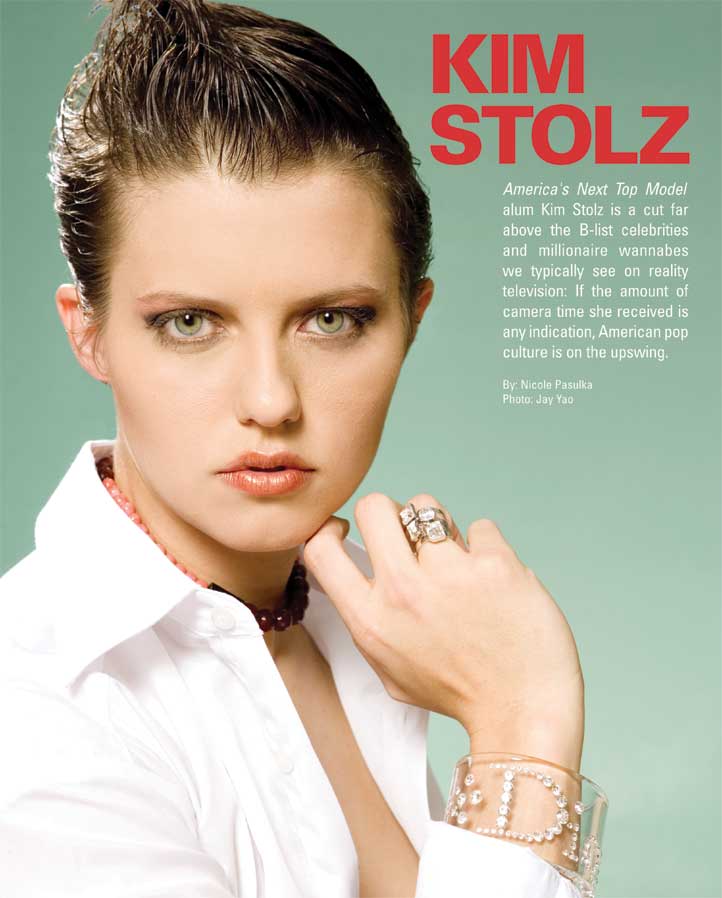
Hot! Out Wesleyan Lesbian Kim Stolz talks to The Village Voice, The Advocate, and AfterEllen.com about her experience on America's Next Top Model. I'll gladly admit that I only watched the show because of her and that I stopped watching the moment she was eliminated. For her sake, and the joy of seeing a tomboyish, almost butch, girl on TV, I put up with the atrocity of all of those other girls, most of whom were particularly idiotic, and the inanity of listening to Tyra Banks talk. While Kim's not always polished, she sports good solid just-out-of -college liberal politics and a general intelligence that makes her interesting to watch. I can't wait to see what she's up to next

What I'm doing for my Winter Break:

A Collection of Random Ramblings

I hadn't been reading blogs for most of last quarter, but now that winter break has set in, I've become completely nocturnal and have been catching up on the wit and wisdom out there in the blogoshpere. I'll share some of my favorites among the things I have learned:

A lovely new find is Beth Spotswood, who amused me with her review of the Brokeback Mountain viewing experience, and delighted me by saying 'hi' in the comments to my post. When I subscribed to her feed, my newsreader for some unknown reason downloaded the last MILLION posts, and I actually read them all. The process was suprisingly fun, and I highly recommend her.

Violet Blue recently posted her list of The Top 10 Sexiest Geeks of 2005. The whole thing is lovely, and I do indeed love sexy geeks, but my favorite discovery was Annalee Newitz. Not only is this a totally cute picture, but I had no idea she was anything other than a standard aspiring academic. How cool is it that one of the people whose book I read for class last year actually understands and writes about technology. Based on her response to King Kong, I'm totally excited to read her forthcoming book, Pretend We're Dead: Capitalist Monsters in American Pop Culture. I love it when academics become cool writers.

The Hammer museum here in LA, which is currently displaying the first half of the Masters of American Comics exhibit (MOCA is doing the later half), will be putting on a puppet rock opera in February. Awesome.

What's even cooler than a puppet rock opera? Zombie super hero comics! Marvel asks one of the great questions of our age, positing: "an alien virus has mutated all of the world’s greatest super heroes into flesh-eating monsters! It took them only hours to destroy life as we know it—but what happens when they run out of humans to eat?!?" We'll see if they manage to develop a story that goes beyond a cool premise, but I'm curious.

Monday, December 19, 2005

John Waters and Peaches

A John Waters Christmas. UCLA Live. Royce Hall. 12/17/05.

I went to this event expecting it to be fabulous, but not really knowing what it would be like exactly. If John Waters was involved, it was bound to be interesting at least.

It began with a good long opening performance by Peaches, who completely rocked. It was a weird show, because the audience was in no way warmed up or prepared for a crazy sextastic punk rock extravaganza. Peaches herself was completely awesome and put on a rockin' show, but she should have been performing in a slightly smaller venue with more alcohol and fewer seats. I totally want to go see a more intimate show of hers sometime soon. Rumor has it she has been showing up/performing at random bars/clubs throughout LA all week, which is awesome. The absolute best thing about her performance, which was generally fabulous, was the fact that she perfomed a whole song about the Hanky Code complete with male and female topless backup dancers. I love that such a song exists and I must own it! For the last song, "Fuck the Pain Away," the audience rushed the stage and acted like it was a real rock concert. Peaches Rocks!

The John Waters part of the show was one big Christmas-themed stand up routine. He was absolutely hilarious and totally engaging and generally wonderful. It was a riff on the things he would like to recieve as Christmas presesnts (obscure books and DVDs) and reminiscing about being poor and stealing things around Christmas time. Because really, what's more Christmassy than stealing? He even did a Q&A session at the end, which I think no one was expecting and yet he managed to answer even the most inane questions with interesting stories and comments.

This whole event was strange and wonderful and I totally loved it. I'm so glad I managed to buy tickets to this event. Even the audience was a wonderful collection of young, crazy Peaches fans and sometimes older but no less crazy John Waters fans. There were men in skirts and eyeliner, all sorts of cute queer women to drool over, and in general some of the most fabulous clothing I have ever seen. There's just no way to express how much I want to own a purple velvet top hat.

P.S. Defamer linked to this extremely elaborate Hanky Code guide which makes me wonder if it's comfortable to walk around with a teddy bear in your back pocket?

Gay Cowboy Roundup

I actually managed to get to Brokeback Mountain not long after it opened. I would have gone opening weekend, except that was completely SOLD OUT because it was only playing in ONE THEATER! What were they thinking?!? This is LA; we're not afraid of gay cowboys!

As for my own review, I loved the movie. I thought it was beautiful and devastating. I feel that it was extremely well done on all sides. I'm not sure how I feel about it politically, what with the whole 'we're manly, manly men' aesthetic in which Heath Ledger is a Man of Few Words who suffers his internalized homophobia in silence. But it's a beautiful story adapted with skill and compassion, and for that I love and respect it very much. And yes, I was sobbing.

I've recently read some great commentary on the movie, though, and that's what I want to share. First, read Beth Spotswood report on the experience of seeing the movie in San Francisco. It's delightful. And then, Susie Bright takes on the conservatives and supports Brokeback Mountain as a political statement. Both of these things make me very happy.

Sunday, December 18, 2005

Schulman Storm

I haven't been reading the blogs recently, and boy have I missed out! Apparently, there was quite a buzz about "Who's Afriad of Sarah Schulman," a (10/23) article by Jesse Green in the New York Times about Sarah Schulman. Schulman is a fantastic lesbian writer. Her collection of articles, My American History is a wonderful documentation of 1980s in New York with an emphasis on the AIDS crisis and the early days of ACT UP. I recently read three of her early novels, now out of print, and I absolutely loved them. Unfortunately, her career as a playwright has been less successful thus far.

Schulman herself often comes across as the stereotypical 'angry lesbian.' She is in very many ways a squeaky wheel, not afraid to speak out, loudly, when she feels injustice. I suspect even the fact that there is an angry lesbian stereotype and that I reference it and repeat it, thus giving it a little more power, is something to which she might object.

Anyway, Jill Dolan wrote a response taking apart the basic prejudices inherent in the article, particularly the tendency in the article to domesticize Schulman, emphazing her home and generally depicting her as 'reformed' and 'tamed' to fit in with the uptown off-Broadway scene. Apparently, Schulman complained to Dolan about the characterization of the work and her personality, causing Dolan to write a second post questioning her own obligations and commitments as a lesbian feminist critic.

Personally, I find the whole thing fascinating. I love Schulman's writing, especially her polemical pieces. She's brilliant when she's angry, and the world needs people to stand up and say 'this isn't right' loudly and frequently. I'm dying to read/see Schulman's play, Carson McCullers: Historically Inaccurate, which sounds fascinating despite its mediocre reviews, but is tragically unpublished. I would love to see a theatrical adaptation of some of her caricatures of the downtown performance art scene from the early '80s in Girls, Visions, and Everything. Though she repeats some critiques of Schulman without firsthand knowledge, I think the main thrust of Dolan's analysis is right on, and important. What I think is most disturbing and offensive about the Green article, though, it the fact that it takes to page two on the online article to even mention the cause of the article, Schulman's new play. While clearly this isn't a review, drawing attention to the play or the trajectory Schulman's career would be much more interesting than this strange indictment of Schulman's personality. And I'm kind of offended that he calls the WOW Cafe a "downtown dive"; that really misses the point and the importance as a venue and a movement. It's a part of the marginalization of lesbian writiers and performers against which Schulman argues. I recently had a lovely conversation with poet Ami Mattison (who seems to be similarly radical and justifiably angry) about Schulman, and she told me to take all of the critiques of Schulman's personality with a grain of salt. Schulman may be loud, but she might also be right. I don't know her personally, and honestly I'd rather know more about her work, and maybe even have a chance to see it, than worry about whether or not she's learning to play nicely with the powers that be in midsize theater. I'm glad she's getting attention, though. One way or another, I think recognition is a good thing. Cheers to Playwrights' Horizon for producing Manic Flight Reaction. I wish I could have seen it.

Sunday, December 04, 2005

Yes, it was a Bloody Mess

Bloody Mess. Forced Entertainment. Freud Playhouse. UCLA Live. 12/4/05.

Forced Entertainment is apparently the UK's answer to The Wooster Group. I hear that they have several digital media performances and shows that integrate film. Bloody Mess wasn't one of those, but it was fascinating nonetheless. It started out with a hilarious clown act between two men, which culminated in the distruction of innocent mismatched chairs of the sort that belong in low budget blackbox theaters. This bit started the audience off laughing and set the spirit and the breakneck pace of the whole show.

Bloody Mess was a delightfully critical deconstruction of the business and labor of theater, moving back and forth between the spectacle of pretentious postmodern performance by the likes of Robert Wilson and the Wooster Group and the excessive effects of a rock concert. While a clever critique, the performance was also entertainment all its own, perfectly capable of captivating an audience for two and a half hours without intermission. It was a crazy, wacky experience that left me emotionally drained and a bit exhausted.

Friday, December 02, 2005

Ooh! Art! What else does it do?

So this is one of those things I meant to post ages ago. A month ago (Nov. 5), I went to The ONE National Gay and Lesbian Archives for the opening of the WEAR ME OUT exhibit. It's a weird selction of stuff, but a super fun exhibit and I totally enjoyed attending its opening. I highly recommend that you go by and check it out.

The funny thing about this exhibit is that, while it doesn't say so anywhere, it's mostly a collection of clothing designed by lesbians and queer women and art made up from such clothing. There are several fashion photographs and and art inspired by queer/lesbian fashion. Everything item was different, and usually a bit of a suprise and a few items, like some random shoes, were almost inexplicable and yet cool.

The critique I could give of this exhibit would be that gay men and transfolk are underrepresented, especially considering their place in mainstream fashion. But I suppose that's the point; this is about the unrecognized and uncelebrated sides of queer fashion. Despite its eccentricity, the collection is fascinating and I had a wonderful time wandering through the exhibit. This exhibit runs through Jan. 29th, so enjoy it while you have the chance. You'll probably never see any collection remotely similar.

Following on the theme of cool art exhibits, there's an exhibit that closes on Saturday (Dec. 3) of the comic art of Gilbert and Jaime Hernandez at the Pasadena City College Art Gallery. Personally, I love the Love & Rockets graphic novels. They're beautiful and weird and intense and the Locas series is the sweetest craziest punk rock lesbian relationship/friendship I've seen in graphic novel form. (via Flog).

And one more gallery exhibit of art originally intended for some purpose other than gallery display... Porn! Yes, it's an exhibit of gay male erotic art entitled Erotic Pioneers Past and Present that features the work of Tom of Finland, Rick Castro, and Wilhelm von Gloeden among others. Runs through Feb. 3 at the Antebellum Gallery, which claims, "Specializing in fringe, fetish, and erotic art, Antebellum to feature artists and work that ranges from traditional to the outrageous. Antebellum will host original curated exhibits, new artists, film screenings, tea salons, readings, forums, and performances." This seems to be the gallery's opening event, and it doesn't seem to even have a website of its own yet; it's all from links off of www.rickcastro.com. I think I'm glad that LA has/will have a gallery that primarily displays erotic art. How crazy is that? Crazy, but kinda cool.

Thursday, December 01, 2005

Cool Reasons to go to Museums

John Waters Film Festival! Super cool. In conjunction with the John Waters: Change of Life exhibit at the Orange County Museum of Art. This isn't a festival of John Waters films (they apparently did that part in the month of November), but it's a series of films selected by John Waters, presumably for their '50s and '60s campiness. It makes me happy that John Waters is being exhibited in an art museum, especially in OC. Pretty awesome.

I'd also love to see the Masters of American Comics exhibit at the MOCA.

Tomorrow is also First Fridays at the Natural History Museum with Jared Diamond talking about the environment and climate change, but sadly, it is sold out.

Next week, Fridays off the 405 at the Getty involves salsa lessons, which is pretty cool.

Also Friday the 9th, the LACMA is showing a preview of Match Point, Woody Allen's new film starring Scarlett Johansson. And speaking of LACMA film screenings, apparently they show crazy old movies there on Tuesdays at 1pm. Up next: Tennessee William's Night of the Iguana starring Ava Gardner and Richard Burton. Hot. I wonder who goes to these on Tuesday afternoons? Probably old people, but it's pretty cool.

Tuesday, November 29, 2005

In Need Of Queer Eye for the Straight Musical

The Drowsy Chaperone. The Ahmanson Theatre. 11/27/05.

The LA Times loved it. Personally, I'd have to say that The Drowsy Chaperone was startlingly deficient on gay people. Apparently, for some that's a good thing, as the Times review asserts ""Director and choreographer Casey Nicholaw (of Broadway's "Spamalot") gives all the performers a long leash when it comes to chewing scenery and winking at the audience, but he rarely allows them to descend into camp." For me, a good sense of camp was exactly what this musical was lacking.

For me, the biggest problem was Bob Martin as the Man in Chair. He played his role well, but far too heterosexually. The role was just a little too painful and pathetic, talking too much about how he was in the closet. This was the abject gay man at its most depressing, played by a very clearly straight man who doesn't actually understand or love the character. This should be a man who celebrates musicals as an expression of his queerness, whether he is open about that queerness or not. There needs to be more love. I'd love to see Nathan Lane go for it, over the top and campy, with passion and love. Martin is one of the creators of the musical, so one could argue that his is the most 'authentic' performance possible. The role was, after all, written for him. And one can assume that yes, he does love the show. But he needs to love and understand the character more so that it's not an uncomfortable travesty of a gay man.

Similarly, I thought Beth Leavel as the Drowsy Chaperone was a little too serious and not quite enough aging diva. It's an astounding role, and it could be wonderful, but it wasn't quite there yet. She should be doing Bette Davis in All About Eve, a little past her prime and severely threatened by the young ingenue. While she had her moments, for the most part she was forgettable. This might have to do more with the part than the peformance, though.

The most fabulous performances for me, personally, were Edward Hibbert (who I saw as Oscar Wilde in Gross Indecency) as Underling, the butler. He was beautifully dry (and all wet) and just the right combination of campy and straight man. I wonder what he would do with the role of Man in Chair? Also, Dannny Burstein as Adolpho the Latin Lover was hilarious and huge and campy and that was wonderful. Eddie Korbich as George, the best friend, was great as well. His dancing was excellent and his character animated. I would have loved to see more of him in this show.

Sutton Foster as Jane, the leading lady, was good. She did her one big show-stopping number excellently, and the most interesting thing about her performance is the intertextuality it creates with her role as Millie in Thoroughly Modern Millie, the kind of role that this musical was spoofing. She's a quirky and interesting performer, and I'm not sure exactly how I feel about her, but I am fascinated.

The other major flaw in this production, I thought, was in Troy Britton Johnson as Robert, the leading man. He couldn't really dance, he was too stiff, and in general completely uncompelling. Which could be read as a commentary on the vacuity of the leading men in some of these shows, but I would rather have seen a good spoof of Fred Astaire than his muddled stiffness.

Right now, this musical rather reminds me of a show that I worked on in high school, a musical spoof of Agatha Christie mysteries called Something's Afoot. That, like this, was a good, fun show but not quite Broadway-quality. I think it could be revised into something Broadway-ready, but I'm not sure it's quite there yet. I'd put it though another round of revisions or give the cast some leeway to rework it a bit. Don't be afraid of being campy; in musicals, that's a good thing.

A lesbian musical?!?

When I hear that there's something out billing itself "The Lesbian Musical," many things go through my head. One of them is certainly, "This I've got to see!" But apparently it's true, and here in LA. So yes, I will be going to see The Breakup Notebook: The Lesbian Musical.

I'm already dubious about the tag line "...because everyone deserves a love song." Ugh. Also, one of the cast members actually made the first line of her bio ""___ is not a lesbian but is thrilled to be playing one onstage." Anyone that weirdly compelled to assert her heterosexuality is pretty lame in my book. But there are some good omens, too. The Musical Director apparently worked on Reefer Madness when it was here in LA and I saw it in a little NoHo theater.

But anyway, I must see it. Previews start Dec. 2 and it opens Dec. 10 for a "limited engagement" of unspecified length. I don't know when, but it's definitely on the agenda.

Monday, November 21, 2005

Ditch the comparisons

Ditch. Akbar. 11/19/05.

Local performance artist Kristina Wong performed numbers from her show, Miss Saigon with the Wind, at DITCH on Saturday. I've long meant to see Wong perform, and I'm glad I had this opportunity, although it's no substitute for an actual show. This particular space creates the strangest performance dynamic ever, because it's a bar, not a stage. There's no platform or real stage space to perform on, so the audience is packed in close around the performer on the dance floor. It's hard to see, and hot and crowded and often loud. Which made Wong's performance of the opening scene of Miss Saigon, in which she played all of the prostitutes (and soldiers) in the Saigon bar, incredibly strange and personal. While it's certainly not an ideal venue, it creates a fascinating performer/audience relationship. Wong's screetchy rendition of the (fairly vile) love ballad from Miss Saigon was hilarious as she switched between a saccharine female voice and an exaggeratedly deep masculine voice. I'm going to have to see more of Wong's performance before I can render judgement, but I must admit I'm curious and will try to get out to see a real show of hers soon.

DITCH at Akbar was superfun; the difference in events between DITCH at Zen Sushi and Ditch at AKBAR is huge. At Zen Sushi, there's a decent stage space and we can actually see and hear the performers and actually pay attention. At Zen Sushi, I've been able to carry on conversations better. But at Akbar, there's something to be said about the crushing crowd and loud music - I danced for hours and had an amazing time! Both times I've been to DITCH at Akbar (actually the first time more than the second), I've been with a smoker, so part of the event becomes going outside for fresh air and a cigarette, where there's more conversation and more meeting people and just standing on the street corner talking and taking a break from the heat and the noise, which is important with these events I think. It's one of the times I'm kind of glad to know people who smoke. The whole secondhand smoke thing makes me feel comfortable, it reminds me of friends of mine from college, pubs in London, and all sorts of other good associations with a bad smell. While they're very different experiences, both DITCH venues are amazing and wonderful in their own ways.

Something to be Thankful for

Trans/giving. 11/19/2005. Plummer Park, West Hollywood. 11/20/2005. UCLA.

This Trans/giving was, I believe, even better than those I have previously attended. Trans/giving was celebrating its second birthday and in doing so, they gathered a pretty great lineup of talent. I love the mix of local talent show and professional artists, but this group seemed especially well put-together Of course, it certainly doesn't hurt that one of the performers was Turner Schofield, my personal favorite performance artist.

Spoken word artist Ami Mattison came from Detroit to perform at this event, and her performance was incredibly powerful. She has a beautiful, powerful speaking style that can really electrify a room. Her pieces are wonderfully political and appropriately angry. They are brilliant pieces of writing delivered compellingly. Personally, I was distracted and maybe the tiniest bit obsessed with her hands, which she used well in general, but often held just in front of her pelvis, drawing attention to her crotch. I spent a lot of time during the performance thinking about what that symbolized, but also not wanting to think about anything but what she was saying, which was great. She has a voice and a style that I would gladly listen to all day long. She was selling her CD, but as far as I can tell she doesn't seem to have an up-to-date website of her own for me to recommend. But if you have a chance to see her, check her out.

Turner Schofield remains the up-and-coming performance artist that everyone must see. He's got all of the skill and talent of the perfomers of a previous generation that I love so much, Holly Hughes or Tim Miller or Peggy Shaw, and he's sweet and committed and accessible. On Saturday night, he performed a piece of Debutante Balls, which I have seen at least 3 times now and I never get sick of it. It is completely compelling and feels fresh every time. He's open and honest with an amazing storytelling quality. His comic timing is perfect, his inflections are beautiful, and he can win over almost any audience. Write your local college or performance space and encourage them to book him immediately.

On Sunday, Turner perfomed a piece fromUnderground Transit, which I had never seen before. This piece felt more like poetry and less like storytelling, and I just wanted to drown in the words sometimes. This piece felt younger somehow, less mature. It was fascinating and extremely well done, but somehow didn't blow me away the way Debutante Balls does every time. In the space of 15 minutes or so, he did 3 full costume changes, sang two songs, and talked about what seemed like a million different things. It was a crazy, brilliant, beautiful rainbow whirlwind. It felt like he was bursting with things that had to be talked about and they came out in no particular order exploding in every direction, so sometimes it was hard for his audience to follow. There were some moments I loved, but they seemed fragmented, too short, out of context. I love his Joe Androgynous, frat boy look with yellow pants and matching visor (do frat boys ever really match?) where he asks "Does this boy look like he's got a feminist consciousness?" and implicitly asks "Is this what I might have become?" It's a wonderful moment, but I'm not sure why or how we got from the suit to the frat boy look. I think my problem is that I didn't get the framing story; however tenuous or stream of consciousness it might be, I needed something more to bring these selections and personas together. What do these ideas have in common? What does the subway metaphor have to do with it all? Who was the woman in the red dress? It definitely made me want to see the whole show and find out.

The other highlight of this Trans/giving was Stephan Pennington on banjo (with Phil Gentry as backup guitarist). They performed a fabulous set that spanned genres from bluegrass to lesbian folk music to rock and roll. Stephan's vocals on "Wabash Cannonball" and the Elvis and George Michael songs were especially provokative and nearly inspired girls to swoon in the aisles. Their set was quite sexy and incredibly enjoyable to watch.

On Sunday, ryka aoli de la cruz performed an intricate and incredibly intense piece of poetry. It was an absolutely beautiful performance reaching over the gap from poetry to performance art. In this piece, cruz shared some things that were so incredibly personal that I as an audience member felt vulnerable for her.

It was an amazing set of performers at this Trans/giving and I am very much grateful that such an event exists, frequently bringing in amazingly talented out of town guest performers. This particular edition of the event was especially powerful and I very much appreciate everyone's hard work and dedication to making it happen.

Monday, November 14, 2005

Fiction and Technology

A thought on the frequent difficulty of accomodating contemporary technology into mainstream fiction. I'm not talking about SciFi here, I'm talking about the everyday stories, the classic plots, adapting to the availabilty of technology.

In many ways, Sarah Schulman was brilliantly presceint in saying, "Everything was getting computerized by the summer of '84, and it was happening so fast, a social critic could hardly keep up with it. Lila was having a hard time building a plot around a WANG word processor" (Schulman 250).

On the plane from Toronto, I was so mentally fried that I succombed to the temptation to watch the in-flight movie, Must Love Dogs. I love Diane Lane and I love John Cussak, so this movie did have some things going for it. But awareness of technology was not one of them. It was an entire movie about internet dating, and yet none of the characters seemed to own a cell phone. Not once or even twice but several times the plot revolved entirely around people showing up at other people's houses without calling first; who does that? It seems unbearably rude to me. The people writing, directing, and performing in these movies must know that this technology exists, why can't they figure out how to use it properly? Get around the awkwardness and the tired old plot devices and think about the way we live now!

Lesbians do Keroac

Schulman, Sarah. Girls, Visions, and Everything. In Triangle Classics: The Sophie Horowitz Story; Girls, Visions and Everything; After Dolores. New York: Quality Paperback Book Club, 1997.

"Lila Futuransky always knew she was an outlaw, but she could never figure out which one."

This is a book I picked up cheap because someone told me I should know about Sarah Schulman's dyke noir phase. In reading it, I am consistently amazed at Schulman's intelligence and prescience. While I would generally be dubious about anyone discussing 'the lesbian experience' in the '80s, I have to love Schulman's class and race politics. I find this rumination on Jack Keroac's On the Road set in the lesbian performance art community in New York fascinating. Her fictionalized Kitch-Inn seems like the best depiction of the WOW Cafe that I've ever read, complete with a hilariously successful 'Worst Performance Festival' and a crazy over night trash aesthetic. Helen Hayes and Mike Miller, poorly disguised representations of downtown queer performance luminaries, are fabulously reflective of the figures I've come to know through my work. While I don't know the scene well enough to tell if more of the characters are directly correlated to some of my favorite performance artists, the similarities and representations are wonderful.

Of course, that's not entirely what the book is about, though I kind of wish it were. It is about Lila Futuransky wandering through the East Village as Keroac wandered across America, doing things and meeting people and reflecting brilliantly. Lila, however, goes on a personal journey in which she falls in love and seems to sort of settle down, a plot line of which I am highly suspicious as a representation of lesbian adventures and trajectories. While my general lack of appreciation for On the Road arises from its excessive masculinity, I might criticize Girls, Visions, and Everything for being a bit too "lesbian" or a bit too bitter in the beginning and sweet at the end, but in general I love it.

Thursday, November 10, 2005

Cool Queer Events this Weekend

I was trying not too drool over all the cool things happening this weekend, because I'll be out of town and thus I cannot go to them all, but I am sad. It's a great weekend for queer film because Outfest is putting on their people of color film festival, Fusion, on Saturday and Sunday. Also, there is a bunch of independent queer film at the Arclight's AFI Film Festival this weekend. I have a friend who's going to see Breakfast on Pluto, in which Cillian Murphy plays a transgendered woman in a '60s nightclub. And together, the two film festivals give you 3, yes 3, chances to see Margaret Cho in Bam Bam and Celeste (although one of them is last Tuesday and you already missed it. sigh.

In terms of performance, the most exciting thing to me is that the Butchlalis de Panochtitlan will be performing on Saturday (Nov. 12) at the Fusion festival at 6PM at Barnsdall Art Park. They're a super-fun group of performers, if sometimes a bit overly theoretical in tone, and totally cute, and I would definitely go see them if I were in town.

Next Top Lesbian

For some reason, I'm not quite sure why because I missed most of this week's episode (I prefer the replay on Tuesdays), Kim from America's Next Top Model, was doing a guest spot on Veronica Mars. My general appreciation of Kim as a vaguely butch face on TV inspired me to allow myself to fall victim to their crossover ploy. It actually worked fairly well - Veronica Mars was pretty good, and I was convinced to watch the whole episode. Kim's acting debut was a little rough- she was servicable but a bit awkward in a minor role as a rental car lackey, but I still believe that she needs to have a career beyond reality TV that will allow me to watch her more often.

Tuesday, November 08, 2005

What's so great about Nov. 19?

The date of Nov. 19th wants to kill me. I was originally supposed to go to a USC football game, but I cancelled that when I realized that it conflicted with Turner Schofield performing at Transgiving, which of course I absolutely must see. If you ever have a chance, I highly, highly recommend that you see Turner's show. This tragically conflicts with DITCH at Akbar that night, which will probably also be awesome. Technically Transgiving ends at 9:30 and DITCH starts at 9, but the last time I was at Transgiving it was absolutely epic, starting an hour late and dragging until everyone was kicked out of the space. Akbar was the location of the first DITCH, and I had more fun that night than I had in a long time. It was an excellent evening and I suspect returning to the scene of the crime will be equally awesome. Also, Kristina Wong is performing at DITCH, an artist that Turner himself has frequently told me I must see. Saturday the 19th is also the UCLA leg of the conference formerly known as QGrad, the Queerscapes conference cohosted by USC and UCLA, but that should be over before the queer performance action really starts.

If you happen to be in San Francisco, Nov. 19th is also the date of the Miss Trannyshack 2005 Pageant, which will I'm sure be an absolutely amazing drag event.

Wednesday, November 02, 2005

Double booked!

At UCLA on Thursday (Nov. 3), 2 exciting queer scholars will be presenting papers at almost exactly the same time. Bad scheduling makes my life difficult!

Karen Tongson from USC will be presenting "From Weissnichtwo to Kalihi: The accent in Queer Provincial Imaginaries" at 4pm in 164 Royce Hall.

Sue-Ellen Case will be presenting ideas from her new book in the Distinguished Lecture Series for the department of Musicology in Shoenberg hall at 5pm.

Friday, October 21, 2005

You say 'relic' like it's a bad thing

Goldoni, Carlo. Arlecchino, Servant of Two Masters. Piccolo Teatro di Milano. Giorgio Strehler, dir. Freud Playhouse, UCLA. 10/21/05.

Ferruccio Soleri first played Arlecchino in 1960 and has been performing this play for 50 years. The production, directed by Giorgio Strehler, has existed more or less intact for even longer, although Soleri is credited with restaging it after Strehler died in 1997. The play itself was written by Goldoni in 1747. It was based on earlier Italian commedia dell'arte which in turn was strongly influenced by Roman Plautine comedy. It's a production with an awfully long history. Sometimes that makes it feel old, especially in that Soleri is 70 years old, so while he did a great job, one can assume he would have been a litle more spry in the role when he was younger.

This was actually a really fun show, in that commedia is a fun genre and this was a strong example of it. There were several ridiculous and hilarious moments and I found myself laughing out loud on occasion. It was, however, 3 hours long, which feels a little extreme for a comedy of mistaken identities and wacky antics. Occasionally it was a bit slow and probably could have been trimmed a bit. There were moments where it felt weird being in a dark theater watching a play that evoked the roots of commedia when it would have been performed in a bustling marketplace.

But overall, I had a great time. Stock characters, slapstick, pratfalls, and other commedia humor still makes for a great show. Soleri was quite agile and did a good job of holding the audience's attention regardless of his age.

Wednesday, October 19, 2005

A Play in Search of A Genius

Svich, Caridad. Iphigenia Crash Land Falls On The Neon Shell That Was Once Her Heart (a rave fable). In Divine Fire: Eight Contemporary Plays Inspired by the Greeks. Ed. Caridad Svich. New York: Backstage Books, 2005.

More people should read this play. It's a play with a great title and a lot of potential. I want to see it, and I want to see it done well. I want a collaboration between Luis Alfaro and Francesca Lia Block, possibly with help from the Butchlalis de Panochtitlan. I believe this play could be amazingly brilliant, but I'm torn. It requires a brilliant video artist, a brilliant sound designer, and a director with vision and a decent urban glam rave sensibility. Plus, there should be an awareness of both queer politics and Latino/Chicano issues and culture.

Apparently they did it at 7 Stages in Atlanta, which I hear has a good queer contingent, so that gives me some hope. There are some pictures here.

Anyway, the play seems totally fascinating, but it's also kind of hard to visualize because projections and music play such important roles in the production. It is in many ways about atmosphere and surface and I'm not entirely sure about what's below the surface but I think it feels right to me. The play is making comments about sacrifice, teenage sexuality, indulgence, and celebrity but it's not saying anything didactically, so it's hard to think about the point below the story and to distinguish that from tone and mood. I need to think about it more. I also need to read Euripedes Iphigenia so I know where Svich is coming from.

But this comes in a series of recent plays in which queer Chicano/a playwrights adapt Greek tragedies. I'd love to see a festival reminiscent of the ancient Greek festival of Dionysus in which three tragedies and one comedy were presented in the span of a single day as a trilogy of related themes. I would put Luis Alfaro's Electricidad at noon under the heat of an LA sun and the powerlines pulsing. Sunset would fall at the end of Cherrie Moraga's Hungry Woman and the rave of Svich's Iphigenia Crash Land Falls... would lead us into the dark. It would be a strange, beautiful experience.

But back to Iphigenia. There are some confusing vaguenesses in just reading the script and I'm not sure what some of the elements really mean. It references maquilladoras and desaparacidos and features a dictador that could be Juan Peron, Hugo Chavez, or George W. Bush, leaving a director or reader to infer what to make of these references. In fact, it felt very topical in terms of Dubya wrangling rebellious Bush twins. The male lead is supposedly a "transgender rock star" but it's unclear whether that means he's a transman or an effeminate biological male. In fact, I'm not sure whether its transgendered politics are in the right place at all, which is a big issue. Is this campy crossdressing or trans awareness? Why do they need to be transgendered; what does it mean? I still have a lot of questions about this play, but I very much want to see it done and done well.

A Good Moment for Brecht

There's a lot of Brecht going on at the moment.

Caucasian Chalk Circle just closed at South Coast Rep.

Threepenny Opera is running at the Odyssey Theatre through Nov. 27.

Mother Courage opens on Oct. 29 at The Theatre at Boston Court.

Are L.A. Theater companies slowly becoming more politically aware? Are they using this for actual contemporary commentary? Will there be audiences? I'm kind of curious, though I hear that the Caucasian Chalk Circle was a little fluffy and uncritical. I'm most interested in Threepenny; Brecht is more fun with more music.

Tuesday, October 18, 2005

More Psychotic

Futher thoughts on 4.48 Psychose, perhaps occasioned by the New York Times article preceeding its performance in Brooklyn.

First, Isabelle Huppert is indeed phenomenal. She manages to be riveting despite speaking for an hour and a half in a language I don't understand without moving. She also appears without makeup in this production, looking her age, tired, even a bit haggard, even though she remains one of the most beautiful women I've ever seen. Her physical, vocal, and facial expression remain extremely articulate, implying that language is almost unnecessary. She remains the strength and the weakness of this production; it could not be done with anyone else, and the minimalist intensity relies entirely on her skill and her fame in certain intellectual circles. Anyone who as not seen her films, for whom she herself is not part of the attraction of this play, who cannot appreciate her uncharacteristic vulnerability, will get much less out of the production.

Second, the fact that the play is in French is not the problem. The fact that the play is so incredibly minimalist that the audience has not even language to rely on makes it more difficult. But the problem is that this is a brilliant, beautifully-written text and the production in many ways foregrounds that text with Huppert's stunning articulation. The drawback is that this makes it feel like a French lesson; the words are clearly spoken but their meaning not fully grasped. Not understanding the words means that much of the mordant humor, the hope, the potential of Kane's text is lost in translation or lack thereof. This production means something so different when you hear the words but not all of their resonances, not the profound depth of their meanings. The very fact that I know and love the text of the play made it more frustrating for me that I couldn't understand all of the words.

Third, while I'm not sure seeing this play in French is the greatest thing ever, and perhaps I would have enjoyed it much more in English, I'm so incredibly glad that I saw this production. It gave me a feeling of insight into how the play itself worked and it was an extremely intense, emotional experience despite the language barrier. I learned that part of how Psychosis works is by putting the audience into almost a trance state, so you can feel the barrenness and desolation about which the character speaks. Emotional vulnerability not only of the actors but the audience is essential to the play. You have to make the audience brutally aware of their own embodiment, the act of sitting there watching, thinking, feeling. It has to be an experience of the self as much as of the play, which leaves me in an incredibly strange emotional state. It leaves me raw, emotional, introspective and that is the greatest contribution of the play.

Monday, October 17, 2005

Tough on the Psyche

Kane, Sarah. 4.48 Psychose. Starring Isabelle Huppert. UCLA Live. 10/5/05.

I didn't post a review of this when I first saw it. Partially because it took some time to think about, partially because the things I have to say about it are about as minimalist as the production itself. But then I read this blog post about the early press for the production when it gets to BAM in New York and I thought maybe it was worth saying something, however conflicted, about my experience at this production.

First of all, my thoughts fall somewhere in between The Playgoer's and the article to which he was responding. I agree with the premise that an informed audience is better than a suprised audiend. I found the idea, however, that fluent French was a requirement for "decent theatregoing Manhattanites" to be profoundly elitist and a bit disturbing. While a solid working knowledge of the "classical" languages would be lovely for all educated adults, it's not a feasible reality in this day and age. Would he be making the same comment about Arabic? Chinese? As a native Californian, I would have understood the play quite a bit better if it were entirely in Spanish because that's the more practical language to undestand in my life. Seeing theater in other languages is a difficult experience and a good thing to do, but it is reasonable to inform the predominantly English-speaking New York audience that a play originally written in English won't be performed in English. Warning the audience makes sense to me.

I also found the assertion that all problems would be solved if everyone would just bother "to read the play beforehand. When it's a classic, like a familiar Shakespeare, it's really no problem to at least follow where they are in the play. Such effort is called preparing. And perhaps what ticks me off is that is what is mocked most in McKinley's article." Now, I can't comment on McKinley's article (I refuse to pay to get it out of the NYTimes archive), but I know 4.48 Psychosis. I've read the play at least 3 times and seen the British Royal Court production twice. I know this play well and I love it. But reading it is a very different experience from seeing it. It's more of a poem than a narrative in which one can "follow where they are in the play" and without any movement whatsoever, there's not a lot of following to be done.

I personally was the recipient of one of these warning letters when I purchased my ticket to the production, and I must admit that I scoffed at it. I was amused at the idea that the audience had to be warned, but I also didn't realize that there wouldn't be consistent supertitles so I was glad to know. And my letter did include encouragement to read the play beforehand and an offer of the text online. Personally, I would much rather have an informed audience than the few people who didn't read the letter and therefore walked out 15 minutes into the show or even worse, boo'd at the end.

Now with all of this discussion, it makes it sound like it was a horrible production and I didn't enjoy it. That is very much not the case. I actually enjoyed it quite a bit. And I'm not at all opposed to seeing plays in foreign languages that I don't understand. This one was strange and fascinating and gave me some good insights into a play I know and love.

The Surrealist Theater is Empty

all wear bowlers. dir. Aleksandra Wolska. The Kirk Douglas Theatre. 10/18/2005.

After all of my disappointment with the Center Theatre Group's season, I ended up seeing all wear bowlers at the Kirk Douglas with my parents this weekend. It was probably a mistake, since I feel so repulsed by Ritchie's programming, but director Wolska worked at my alma mater right before I got there, so I feel a personal connection that motivated me to see her work.

This piece was quite entertaining and flawlessly executed. Trey Lyford and Geoff Sobelle are extremely talented perfomers and the production itself was quite clever. It began with delightful clown routines and playful gestures, and by the end it was mildly terrifying and evoked existential dread. The perfomers all seem extremely well-educated, perfectly familiar with the Beckett, Magritte, and Laurel and Hardy upon whom they were building.

Unfortunately, the performance itself left me asking, "so what?" It was entertaining, but was there a point? They are clever and witty, but why should I care? It seemed to be all empty virtuosity that was tragically irrelevant. They certainly didn't manage to change my mind about Michael Richie's programming for CTG. And halfway through the play I was struck by the shocking revelation that Ritchie is completely evacuating the potential of the Kirk Douglas as a space in a shameful way. They are going to dedicate it almost entirely to children's theater and productions from elswhere and completely write it off. That's a tragic failure to live up to its potential and Gordon Davidson's plans.

Saturday, October 15, 2005

More on Pinter

I believe I can be a little more articulate on my feelings about Pinter - I was reacting in a hurry earlier. I am glad that a playwright won the Nobel Prize. I believe Pinter deserves quite a bit of recognition for what he has done. He's a fascinating playwright mostly because his plays have a great deal of depth that leaves room for actors' and directors' interpretation. However, his portrayals of women disturb me profoundly. They are all a combination of uptight frigid bitch and whore. Seriously, think of Ruth in The Homecoming or the woman in The Servant or Stella in The Collection. He's working out some serious sexual issues with women by turning them into these weird dark fantasy creatures. Even creepier that most of these women were played by Vivan Merchant, who was his wife. So if you can turn off all feminism and other forms of identity politics (Pinter's characters occasionally make really strange racist remarks where you don't know if Pinter is making fun of his characters or not and I believe almost all of his plays are all white) then sometimes you can enjoy how nasty the people are to each other, but I always have reservations. Pinter's plays aren't enjoyable, and generally they aren't really political either. Thinking about the implications generally upsets me. The thing he seems to be doing most with plays such as The Lover or The Homecoming is shattering middle class repressed sexuality, which is a good thing, but he seems to do it in such an anti-woman way that it disturbs me. Not that his men necessarily come off well, but the women always seem to be a bit of this same woman.

Friday, October 14, 2005

Whatever Happened to Crazy Joan?

Lypsinka. The Passion of the Crawford. The L.A. Gay and Lesbian Center's Lily Tomlin Jane Wagner Cultural Arts Center. 10/14/05.

John Epperson as Lypsinka as Joan Crawford in The Passion of the Crawford. Well, if that isn't a giant mess of identities, I don't know what is! In many ways, I don't know what to make of this show. Now don't get me wrong; I thoroughly enjoyed it. I laughed out loud and I laughed often, but it wasn't quite what I expected. I anticipated a sort of collage show of Crawford's greatest and lowest moments and especially bits of Mommie Dearest. Instead, Lypsinka perfomed mostly excerpts from a live interview with Crawford (in front of a live audience), which provided an interesting object on which she could practice her art.

The performance became very much about Lyspinka's gestures and facial expressions, particularly the way in which she punctuated the pauses in Crawford's speech with tics and twitches and the way she reacted to the interviewer, who was played delightfully by Steve Cuiffo. My favorite moment was when she was reminiscing about the star system and said "but I don't live in the past." I wish I had an exact quote for this because it was very meta.

The interview was occasionally cut with interludes of Joan singing, which were extremely strange, and scenes from another interview in which the inteviewer visited Crawford's home at Christmas, suggesting the reality of Mommie Dearest. After the interview section, Lypsinka performed Crawford reading a strange children's poem, which was even weirder. This part was a little slow, and since the poem made very little sense, my mind kept wandering. In the end was a final breakdown, in which a bunch of very short clips of Joan were spliced together into a collage of insanity, which was kind of fun. I felt bad because I didn't necessarily get all the references, being most familiar with Crawford from Mildred Pierce and Whatever Happened to Baby Jane, but a lot of the sections were actually bits from the earlier interview so that worked out OK.

Crawford is such an interesting person to impersonate because later in her career (Whatever Happened to Baby Jane) she became such a mockery of herself anyway. With her giant bushy eyebrows and broad shoulders, she looked like a drag queen herself. It was interesting to see the video montage at the beginning of the performance which included plenty of her earlier work and even some musicals, because I was suprised to be reminded that at one time she actually was a beautiful women. She says in the interview that she could never play an ingenue, but she was indeed actually a starlet and at one point she looked the part.

Thursday, October 13, 2005

Reflections on Pinter, Nobel Laureate

Harold Pinter won the Nobel Prize. Of course this is quite an honor, and playwrights, especially extremely political playwrights, are rare recipients. The New York Times makes a good point about Pinter seeming to be a political choice for the Nobel Committee - he's a vocal opponent of the Iraq war. In fact, he recently announced that he was retiring from playwriting in order to concentrate on political writing and poetry.

I've spent a fairly significant amount of time with Pinter's plays recently, and I have to say that I'm not entirely a giant fan of Pinter's writing. It is endlessly fascinating, mentally stimulating material with which to work, but I've never particularly enjoyed watching it. All his plays have the same rhythms, the same speech patterns, and a very similar set of mysterious incidents, so en masse they seem rather overwhelming and somewhat monotonous. And bad productions of Pinter are quite possibly the most miserable experience on the planet.

Pinter is certainly brilliant and quite deserving of theis phenomenal honor, even if he's not always for me.

Friday, October 07, 2005

John Fleck makes a great lesbian

Greenspan, David. She Stoops to Comedy. The Evidence Room. 10/7/05.

John Fleck is my hero. He's hilarious. He can make just about anything funny. And in this case, he played a lesbian with no costuming, no elaborate drag, no offensive sterotypes; it was wonderful. She Stoops to Comedy is a play about an actress, Alexandra Page, whose estranged girlfriend is heading off to Maine to do Shakespeare in a barn (haven't we all been there at some point?). In order to make sure the girlfriend doesn't fall in love with a costar (or various other possible motivations), Alex heads off to take the role of Orlando opposite the girlfriend's Rosalind in As You Like It. Cross-dressing without costume changes and complicated sexual tension ensues. I could watch John Fleck play a lesbian diva for all eternity. He was awesome and over the top, but entirely with voice and gesture - the play was quite sparse in terms of costumes and sets and Fleck looked like Fleck whether playing Alexandra Page or Harry Sampson.

The script itself was a bit too self-indulgently PoMo at times. There were moments where it dragged and some moments were extremely awkward. And the entire heterosexual director subplot was boring and extraneous. I don't even know what to make of the whole gay man "who needs another play about me?" section. I think I might have been offended by that. But on the upside, Shannon Holt played dual roles as a rival diva and a lighting designer/archeologist who also happened to be ex-lovers and had an amazing, hilarious scene together. While there were some problems, overall this production had some moments of brilliance that make it absolutely worth the trip. I thoroughly enjoyed it.

Tuesday, October 04, 2005

Is one trial as good as another?

Lawrence, Jerome and Robert E. Lee. Inherit the Wind. New York; Bantam Books, 1960?

Inherit the Wind is a fictionalized version of the Scopes Monkey Trial. The names have been changed to protect the historically inaccurate, but there's no attempt the hide the fact that they're rehashing the trial. Clarence Darrow becomes Mr. Drummond and William Jennings Bryant becomes Matthew Harrison Brady; it doesn't take much sleuthing to find the similaritites. What is most interesting, however, is the fact that the play, written in 1955 about a trial that took place in 1925, says that its time is "Summer. Not too long ago." and that it takes place in "A small town." I'm not the first one to think that this great American Courtroom Drama was written with the McCarthy hearings in mind, nor that it's become strangely relevant once again as the Kansas City School Board battles over Intellligent Design. While it is supposedly creationism against evolution on the witness stand, in reality it is freedom of speech. But these are not the same issue. Inherit the Wind is about the right to disbelieve, to question, to think. It's not really about evolution, though of course that is in there as well. It's about learning. And in a way it says that it's better to be a believer than a cynic; Mr. Hornbeck the athiest newspaperman doesn't come off very well in the play. It's a play about great men battling over great ideas, in the fine tradition of Roman oratory, though of course it it Rachel whose soul is at stake and who, in the end, learns to question authority and think for herself.

But what does the title mean: "He that troubleth his own house Shall inherit the wind?" Both of these men are all wind, really, and in a way Matthew Harrison Brady is the tragic hero of the piece - we can tell because he dies at the end. The quote seems to say 'don't rock the boat' which is not exactly the point of the play.

Katherine of Arrogance, Kate the Cursed

Lombardo, Matthew. Tea at Five. Pasadena Playhouse. 10/2/2005.

For me, Tea at Five was a fascinating play that fell apart at the end. In this play, Kate Mulgrew played Katherine Hepburn, at her parents' beach house at Fenwick, Connecticut at two points in her life, 1938 and 1983. According to the program note, the play was written for Mulgrew based entirely on the fact that Lombardo noticed a resemblance between the two. And in many ways, the strength of the play was indeed the imersonation Mulgrew did. It came on strong at the beginning with a heavy accent. The first act in many ways was about Mulgrew posing to affect Hepburn's long, active, lounging look. This act takes place in 1938 as Hepburn retreats from Hollywood after several box office flops to wait to hear if she got the role of Scarlett O'Hara in Gone with the Wind. What a different movie that would have been! She talks about her relationships, her family, her stage carreer, and my personal favorite was her performance of the morbid calla lillies scene from The Lake, famous for Dorthy Parker's review that "Hepburn ran the gamut from A to B" and Hepburn's subsequent performance of the scene in Stage Door. This act was a little stilted at first, but quite fun once it got going. Mulgrew's technical imitation was excellent, if a little charicatured, and very clearly drawn from a lot of watching Hepburn's movies.

The second half, however, disturbed me a little. It a lot of ways it was the Hepburn I was most familiar with: old, fragile, a little shaky. It was Hepburn in 1983 and she seemed more sorry for herself than spunky. She did a some reminiscing about Spencer Tracy, basically saying that even if he mistreated and abused and never acknowledged her, it was good to have someone who needed her. It was a weird self-effacing depiction of Hepburn as tragic figure and way too psychological. The play seemed really focused on the men in Hepburn's life, the fact that she never got approval from her father and then looked for that mistreatment from Tracy. The whole thing creeped me out.

Honestly, I enjoyed Cate Blanchett as the Great Kate in The Aviator more, but I think that's because the part was more well-written, less stilted and actually showing more personality. I would love to see Mulgrew do Kate in a better vehicle, because I feel that this play was unfortunately not as well-written as it could be, though it was fun to see.